
Brooke County Owner of Record Card
The Brooke Assessor's parcel card labels one line CURRENT OWNER. Around it sit the mailing address, street address, legal description, and deed book and page. Sales history and assessment data round out the record. Map and parcel details appear there too. The field reflects what the assessor carries on the tax roll for valuation, while a recorded deed names the actual grantee of a conveyance.
| CURRENT OWNER | Name carried on the Brooke assessment roll |
|---|---|
| MAILING ADDRESS | Tax correspondence destination, not proof of residence |
| STREET ADDRESS | Physical or situs location of the parcel |
| Map/Parcel | Tax map key connected to assessment and GIS |
| Deed Book/Page | Recorded reference to confirm with the clerk |
| Sales History | Transfer clue that is not a complete title chain |
Treat the mail field as a label, not an invitation. Tax notices can travel to a post-office box. They can also travel to another city or an off-site address. Parcel location and mail destination answer different questions. The Brooke Assessor property card shows the owner and deed-reference fields in context. It works as a visual key.
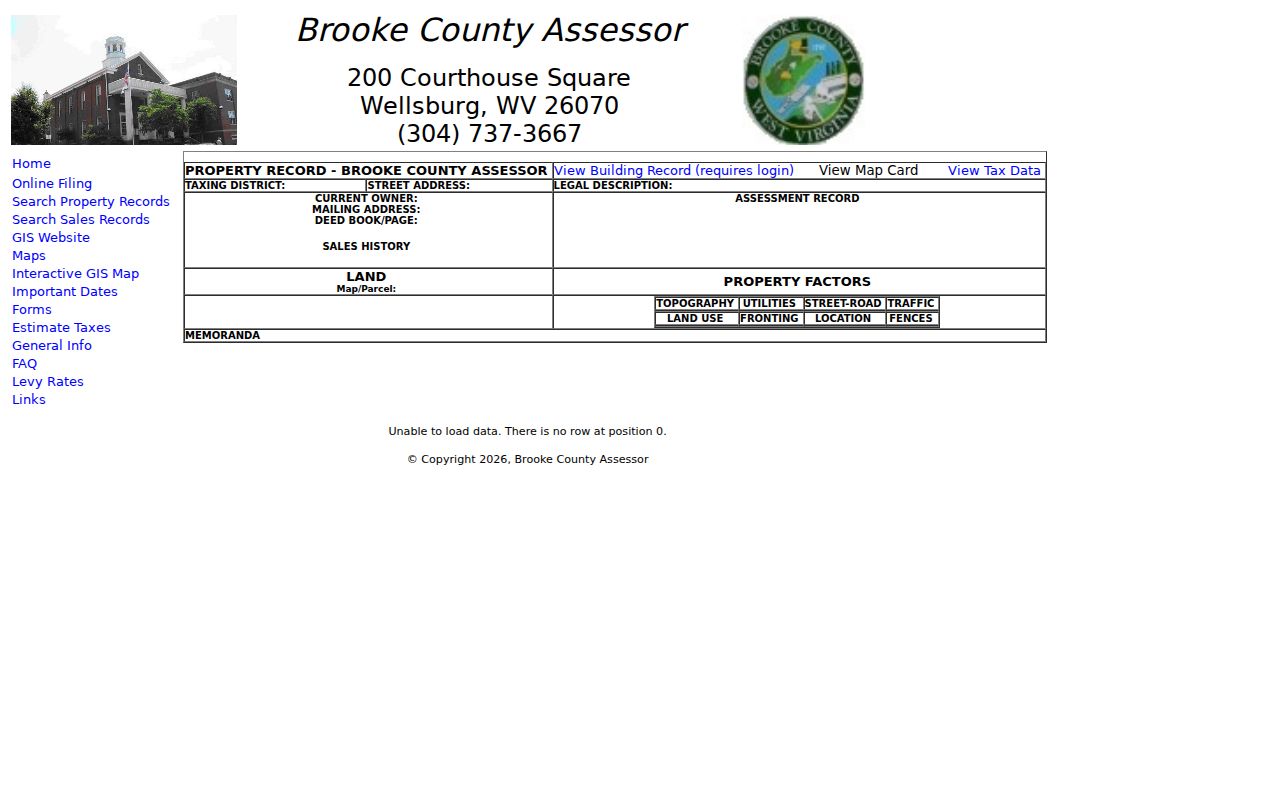
Pull the document reference from the card first, then verify the grantee named on it with the Brooke County Clerk.
Brooke County July 1 Owner Snapshot
Brooke County values property each July 1. The tax picture runs a year behind. The Sheriff's July bill is based on property deeded in the taxpayer's name as of the previous July 1. A deed recorded after the snapshot may therefore name a newer owner than the bill or assessment display. This is a timing difference, not a conflict. Write the deed date, assessment year, and tax year beside any name you verify. That habit prevents false alarms. The newest County Clerk instrument is the transfer evidence, and the tax bill shows the Sheriff's record for its own cycle.
Brooke Mailing and Situs Fields
The parcel card carries both a MAILING ADDRESS and a STREET ADDRESS. The street address is the situs, the physical location. The mail field is just where tax notices go. It might hold a PO box, another city, or an off-site destination. It neither proves residency nor invites personal contact. MapWV's E-911 search works from a physical address and excludes rural routes and PO boxes. The situs field can be missing or inconsistent at times. Fall back on the parcel number, map, or legal description in that case. That combination still locates the property.
Confirming a Brooke County Owner
Confirm any tax-roll name against the newest recorded deed. Start with the parcel card. Carry its exact legal description and book/page to the County Clerk. There, compare grantor, grantee, instrument date, and parcel description, and if the deed is newer than the assessment snapshot, retain both dates instead of treating the card as the latest transfer.
- Search the Brooke Assessor by physical address, owner, account, or map/parcel.
- Copy CURRENT OWNER, deed book/page, legal description, and the card’s date context.
- Ask the County Clerk for the latest recorded deed and compare its parties and land description.
- If the grantee is an entity, check its filed name and status through the West Virginia SOS business search.
- Owner of record
- The owner name displayed by a particular official record.
- Assessment roll
- The county’s valuation and tax record for a parcel.
- Situs address
- The physical parcel location, distinct from mailing address.
- Recording lag
- The time between a deed filing and a later roll or bill update.
Brooke Entity and Estate Ownership
A deed may vest Brooke County land in an LLC, corporation, trustee, or estate rather than an individual. The assessor's card shows only the tax-roll name. The recorded deed supplies the capacity and legal grantee. West Virginia's Secretary of State business search can show a company's status, registered agent, principal office, and filing history. It does not identify every beneficial owner. It cannot replace the deed.
Estate transfers take one more step. Check the Brooke County Clerk probate file for a will, appointment, inventory, or authority to sell, then compare the fiduciary deed. Historical Archives lists Brooke wills and indexes from 1797 to 1926 and inventory books from 1809 to 1928; later probate access is a clerk question.
Brooke Owner Records and Older Deeds
The County Clerk's public page publishes no verified modern cutoff for online deeds. State Archives tells a different story. It identifies Brooke deed indexes from 1797 to 1948 and deed books from 1797 to 1901, along with trust deeds, liens, surveys, and other records. A current reference can point to an older book. Ask the clerk about access in those cases. The archive inventory helps you locate the right series. For the full address-to-name route, see how to find a Brooke County property owner.
What the Current Owner Card Cannot Show
The tax roll proves no occupancy. It does not clear title either. A deed book/page can point to an instrument that was corrected, assigned, or superseded. When ownership carries legal or purchase consequences, compare the latest deed, relevant releases, and any probate or court order.
Limits of Brooke County Current Owner Data
A public tax-roll name settles very little. It does not establish who lives at the property, who benefits from a trust, or whether the title is free of claims. For real diligence, use the recorded deed plus court, probate, lien, and release records. And never infer occupancy from a mailing field.
Lawful use. Brooke County records support property research and civic review. Do not use an owner name or address to stalk, threaten, or harass anyone.
Reading a Brooke County Current Owner Card
The Assessor's detail page treats the current owner as its own field. It stays separate from both the parcel's physical address and the owner's mailing address. That split matters. Plenty of owners get tax mail at another home or through a business address. The two addresses rarely tell the same story. Around the owner name, the card gathers the legal description, deed book and page, sales history, land information, and assessed value. Treat these fields as cross-references. The deed reference points to the recorded instrument, while the assessment figure belongs to the tax record.
Searching is free. The public assessment search accepts an owner name. It also takes a parcel address, account number, district, map/parcel, property type, legal description, or deed book and page. Building information, though, sits behind a login. A public result may not include a full improvement record. If something looks thin, save the account and parcel identifiers and ask the Assessor which card or building details are open to public review.
Timing also plays a part. Recording and assessment maintenance are separate processes. A freshly recorded deed may not show up right away in the owner field. Compare the instrument's execution and recording dates with the assessor page's data, noting when you checked each one. If the dates disagree, the Clerk can confirm the recording entry and the Assessor can explain the tax-roll update. Keep perspective here. Neither system alone establishes a complete title chain, possession, or the identity of everyone holding an interest in the property.
Brooke County Current Owner and Tax Year
The current owner field and the tax bill can reflect different points in the annual cycle. Brooke County bases a bill on ownership as of July 1 of the prior year and generally mails bills in mid-July. A recent deed can therefore appear in the County Clerk’s record before a tax bill carries the new name. Keep the instrument recording date, assessment-card retrieval date, and tax year distinct when deciding whether a result is current.
The assessor detail page’s sales history is another clue, not a complete list of every conveyance or interest. Compare any sale entry with the cited deed book and page, then read the deed itself. An entity, estate, trust, or fiduciary can appear in the chain, and the tax record does not show all underlying relationships. Court orders, probate files, liens, and releases may explain a transfer or claim that is not obvious from the current owner label.
For an office correction or question, provide the account number and district/map/parcel rather than relying only on a person’s name. The Assessor can explain its card and the County Clerk can confirm a recorded instrument. Save a copy or note the date and source of each confirmation so future research does not confuse a current tax-roll name with the latest recorded title evidence.