
What Brooke County Property Tax Records Show
A Brooke County tax record answers several distinct questions. Assessed value, parcel class, exemptions, and the amount due each live in a different field. The Assessor's record carries the current owner, map and parcel number. Sales history and assessment detail appear there as well. Bills, payments, delinquency, and tax-year status belong to the Sheriff Tax Office. Remember, a tax bill is not a deed. Its addressee can simply reflect the ownership date from the prior July.
| Field | What It Shows | Where |
|---|---|---|
| Assessed value | Taxable assessment shown by the county | Brooke Assessor |
| Market/appraised value | Assessor’s full-value estimate | Brooke Assessor |
| Homestead | Reduction from assessed value when qualified | Assessor application and tax record |
| Tax bill/status | Amount, payment, delinquency, certification | Sheriff Tax Office / State Auditor |
| Class and levy context | Property tax class and taxing bodies | Assessor and Sheriff |
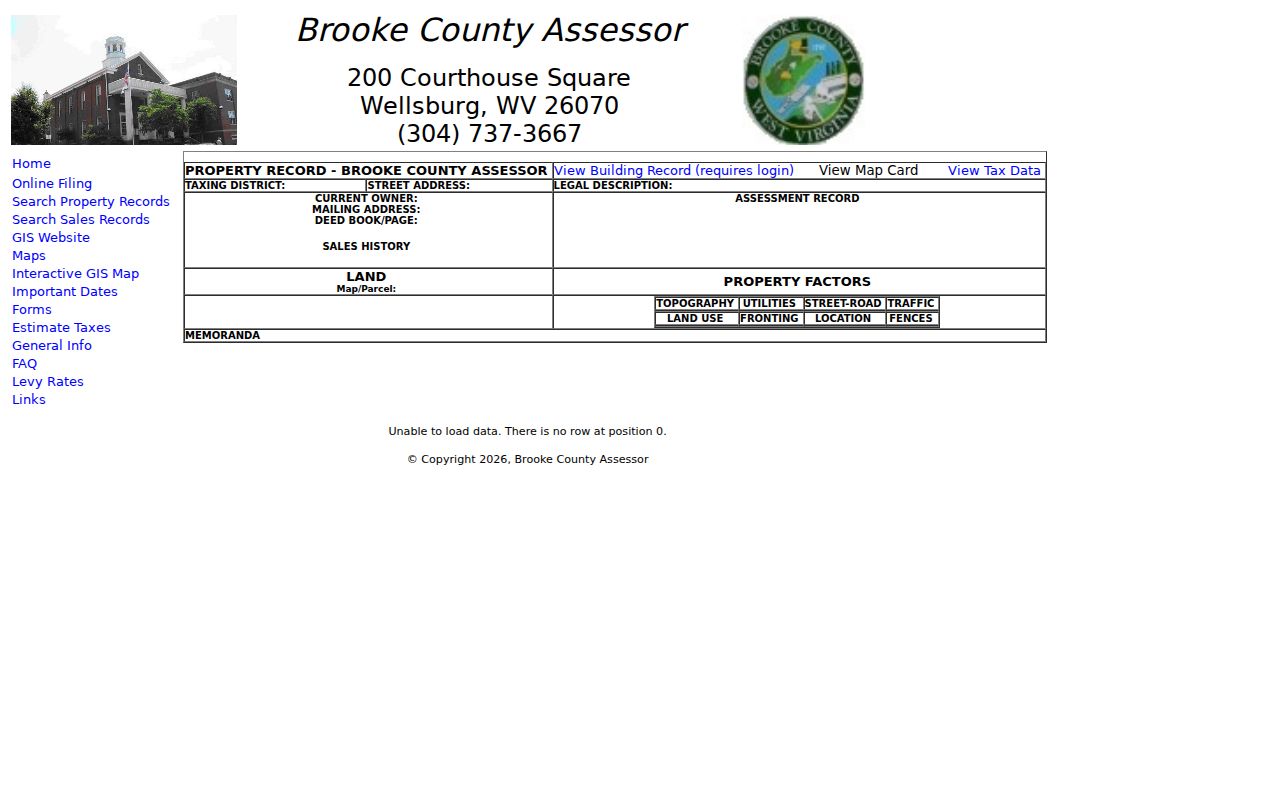
Assessed value in Brooke generally comes out to 60% of market or appraised value. That figure is not a sale estimate. The assessor sets no levy either. Instead, the bill layers county, municipal, school-board, state, and special levies onto the taxable base. The Brooke Assessor property card breaks out owner, address, and deed reference. It also shows sales history and assessment fields. Those headings help you tell the parts of a tax record apart.
Treat the assessment year and the bill year as separate labels. Comparing values or an amount due across records only works when each figure keeps its own year attached.
Brooke County Assessment Date and Value
Each July 1, the Assessor sets a new value on every parcel in Brooke County. Multiply the market or appraised figure by 0.60. You generally have the assessed value. This is the taxable base rather than an appraisal for a sale. A buyer weighing two homes should keep three figures in separate columns. These are the assessed amount, the market estimate, and the recorded sale price in the deed records. Each one comes from a different record.
Assessor staff handle valuation only. They do not set the total levy. That rate blends county, municipal, school-board, state, and special levies into the tax calculation. The assessment card may also list a land and building split. Property factors can appear there too, such as topography, utilities, road access, traffic, use, frontage, location, fences, or memoranda. Those fields explain the card's logic. They do not replace an independent appraisal.
Brooke Tax Class Follows Location
Tax class in Brooke turns on location. Class II covers owner-occupied residential property and farms. Class III applies to other property outside a municipality. Class IV applies to other property inside one. The county names Bethany, Beech Bottom, Follansbee, the Brooke portion of Weirton, Wellsburg, and Windsor Heights as its municipalities. Read the class only as a tax classification. Never treat it as proof of zoning, business use, or who lives there now. A Weirton postal address can sit in either Brooke or Hancock County. So confirm the county and municipal boundary before comparing the tax context of nearby parcels.
Brooke Homestead Reduction
The assessor's FAQ describes a $20,000 homestead exemption from assessed value. It does not erase market value or wipe out the whole bill. Eligibility starts on the first July 1 after a taxpayer's 64th birthday. A separate disability route exists, and the county also describes it. Ask the Assessor for current application steps and proof. Inferring eligibility from an owner name or tax class is risky. Compare an assessment card with a bill. Check whether the exemption is already applied. The taxable amount may fall below the assessed value shown elsewhere. Keep the application year tied to the parcel, especially after a deed transfer. The same caution applies after a parcel split.
Looking Up a Brooke County Tax Bill
The Sheriff Tax Office runs the public tax inquiry and posts the payment calendar. Search by parcel or account when you can. Note the tax year, the first- and second-half amounts, and the payment status. Also check for any prior-ticket or additional-unpaid flag. If a label looks unclear, ask the office about that account. Do not guess at the reason behind the message.
- Open the Brooke Sheriff tax inquiry and locate the parcel or taxpayer record.
- Record the tax year, amount due, payment status, and any note about prior unpaid tickets.
- Compare the Assessor card for assessed value, tax class, and homestead status.
- For delinquency or certification, follow the current Sheriff and State Auditor instructions.
- Assessed value
- The taxable value, generally 60% of market/appraised value in Brooke.
- Levy
- The rate set by taxing bodies and applied to the taxable base.
- Homestead
- A $20,000 reduction from assessed value for eligible applicants.
- Tax delinquency
- An unpaid tax status that can lead to publication and certification steps.
Brooke County Tax Bill Dates
The Sheriff mails tax bills in mid-July to the last known owner and address. The county tax year runs July 1 through June 30, and a bill is based on ownership as of July 1 of the previous year. The first-half payment receives a 2.5% discount through September 1; September 30 is the base amount. Interest begins after October 1 at 0.75% monthly, or 9% annually.
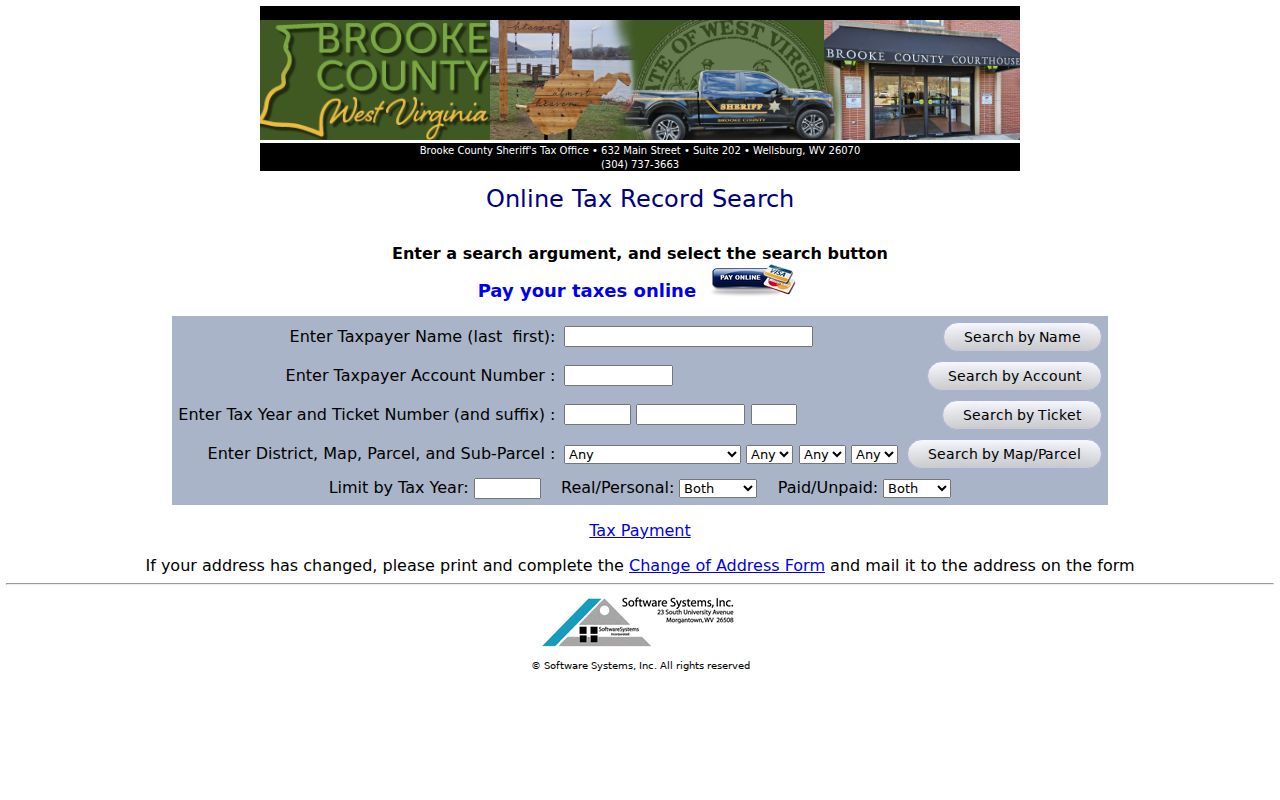
The Brooke Sheriff tax FAQ states the discount and interest timing. Its screenshot below shows the published tax process. If a current portal label or payment balance differs, contact the Tax Office for the parcel and year.
Read any payment record alongside its tax year. A newly recorded deed may post well after the ownership snapshot that bill used.
Brooke Delinquency and Certification
Unpaid real-estate taxes in Brooke County turn delinquent on April 1, and publication fees are added May 1. The Sheriff follows the current SB 552 process. Under it, unpaid taxes are certified to the State Auditor after close of business on October 31. Certified letters go out the following September to the last known owner or a known new owner. That old November courthouse lien sale is gone. Redemption now runs through the Auditor.
Checking a distressed property takes more than one source. Compare the Sheriff inquiry, the published delinquent list, State Auditor certification and redemption records, County Clerk notices, and any circuit-court case. Each source answers a different question. A tax bill, a delinquency, a certification, a redemption, and a final deed are distinct steps, and a tax flag is only a lead to confirm, never proof that the property has already transferred.
Reviewing a Brooke County Assessment
The Assessor uses July 1 as the assessment date, per the office FAQ. Assessed value runs at 60 percent of market or appraised value. The county publishes no appeal deadline or board calendar. Do not rely on a generic date. Review the parcel card first. Then contact the Assessor promptly to confirm the current review process, the filing window, and the evidence format.
Appeal window. The current appeal deadline was not verified in the reviewed Brooke sources. Ask the Assessor which board or review step applies and what date controls before preparing a challenge.
Brooke County Tax Bill Timing and Delinquency
Brooke County’s fiscal tax year runs from July 1 through June 30. The bill is based on ownership as of July 1 of the prior year and is generally mailed in mid-July. That timing explains why a bill can still carry a former owner’s name shortly after a sale: the tax-roll basis and the recorded transfer do not change on the same schedule. Use the parcel or account number when asking the Sheriff Tax Office about a bill, and keep the deed date separate from the tax year.
The county FAQ describes a 2.5 percent discount for the first half when paid through September 1. The base amount is due by September 30; interest begins after October 1 at 0.75 percent per month, or 9 percent annually. An unpaid bill becomes delinquent April 1, with publication fees beginning May 1. Check the current bill and office instructions before payment because a fee, payment posting, or later correction can change the amount due.
State law changed the old county courthouse lien-sale process. After certification to the State Auditor following October 31, redemption questions move to the Auditor’s process rather than a November courthouse tax-lien sale. Ask the Sheriff whether the parcel has been certified and contact the Auditor about redemption requirements. A tax inquiry can establish the status shown by the tax system, but it does not replace a deed or title review.
Brooke County Homestead and Assessment Classes
The Assessor sorts property by statutory class as well as by parcel. Class II covers an owner-occupied home or farm. Class III covers other property outside an incorporated city. Class IV covers other property inside one. A parcel near a municipal boundary should be checked against the legal city limit rather than a postal address, since the class changes how assessed value is treated for tax purposes.
Eligible homeowners can claim a homestead reduction of $20,000 in assessed value. That is not a cash credit. The age route opens after the first July 1 following the owner's 64th birthday. The county also identifies a disability route. Ask the Assessor which application and proof are required now, and whether the exemption already appears on the parcel card. A prior owner's eligibility does not carry over automatically.
Start any correction by comparing the parcel card with the property's actual characteristics and the deeded description. Mismatches happen. Confirm the review office and current deadline with the Assessor directly, since the county publishes no single appeal calendar. Keep a copy of the card and supporting documents. Note the date of your office contact.
Confirming a Brooke County Tax Account
Use the assessor account number or district/map/parcel when contacting the Sheriff Tax Office. An owner-name search can find a likely bill, but the parcel identifier makes it easier to confirm that the inquiry concerns the correct land. Keep the tax year, half-year payment, and current amount due in your notes. If a payment was recently made, ask whether it has posted before treating an online balance as final.
For a transfer, compare the deed’s recording information with the tax bill’s ownership basis. The bill is tied to ownership as of July 1 of the prior year, so the person who receives a mid-year bill may not be the person named on the newest deed. The parties may need to address prorated tax between themselves at closing, but the county’s tax account remains tied to its statutory billing cycle. Ask the Sheriff how a payment or adjustment is shown on the account.