
Tracing Former Owners of a Brooke County Property
Build the chain one transfer at a time. A current assessor card may show the newest deed book and page. The deed itself names the parties. It also describes the land. From there, work backward by hunting each grantor as a grantee in an earlier book. Match the tract or lot language first. That check keeps the wrong name out of your chain of title.
| Transfer Date | Grantor → Grantee | Instrument | Book/Page |
|---|---|---|---|
| Latest deed date | Copy both parties from the current conveyance | Record the stated deed type | Copy the assessor or clerk reference |
| Prior deed date | Latest grantor as prior grantee | Match the legal description | Record the earlier clerk reference |
| Older book date | Continue through the prior grantor | Check deed, fiduciary, or court transfer | Note archive volume or reel if used |
For a recent transfer, use the clerk's current index and ask about image access. Older owners need a different route. The archive's dates point to the right reel. Probate files explain estate gaps, and directories or newspapers can link a historic address to a present parcel without ever replacing the deed.
Walking the Brooke County Deed Chain Backward
A grantor conveys an interest in the land. The grantee receives it. Start with the current grantee. Move back to the grantor who conveyed to them, find the deed where that party took title, and repeat the step. The method reveals former owners, though a name-only search can tangle similar people or miss a spelling change.
- Use the assessor’s deed book/page to identify the newest conveyance and record its legal description.
- Read the grantor, grantee, deed type, date, and any prior-instrument reference.
- Search the grantor as grantee in the preceding period and match the land description.
- Repeat until the modern index ends, then identify the historic Archives volume or microfilm.
- Grantor / grantee
- The parties conveying and receiving the deed interest.
- Chain of title
- The linked sequence of recorded conveyances for a parcel.
- Legal description
- Written land terms that can outlast a street name or number.
- Reverse index
- A search from the latest grantee back to the prior grantor.
Brooke Grantor-Grantee Names Need Variants
Names shift across deeds, estate files, and tax cards. When the first pass fails, try initials, a middle name, a married name, corporate spellings, trustee capacity, and "Estate of" wording. Keep the parcel description beside the name. That habit keeps two people with the same surname from merging into one false owner of record.
A deed entry may list a spouse, officer, or fiduciary whose role matters. Note every party. Record the acknowledgment details, then follow assignments, releases, and correction deeds. Do not stop at the first matching sale-history line.
Brooke Archives Hold Older Land Series
Brooke County's older land records survive in remarkable depth. The West Virginia Archives lists deed indexes covering 1797-1948 and deed books from 1797-1901. The same catalog includes trust deeds and surveys. It also lists oil and gas leases, homestead declarations, and judgment liens. Some trust-deed and lien series run later still. Keep one caution in mind. A catalog listing does not mean every scan can be searched online.
Start with the West Virginia Archives county inventory to find the right series. Then contact the clerk or the archive. Confirm the reel, the book, and how to gain access.
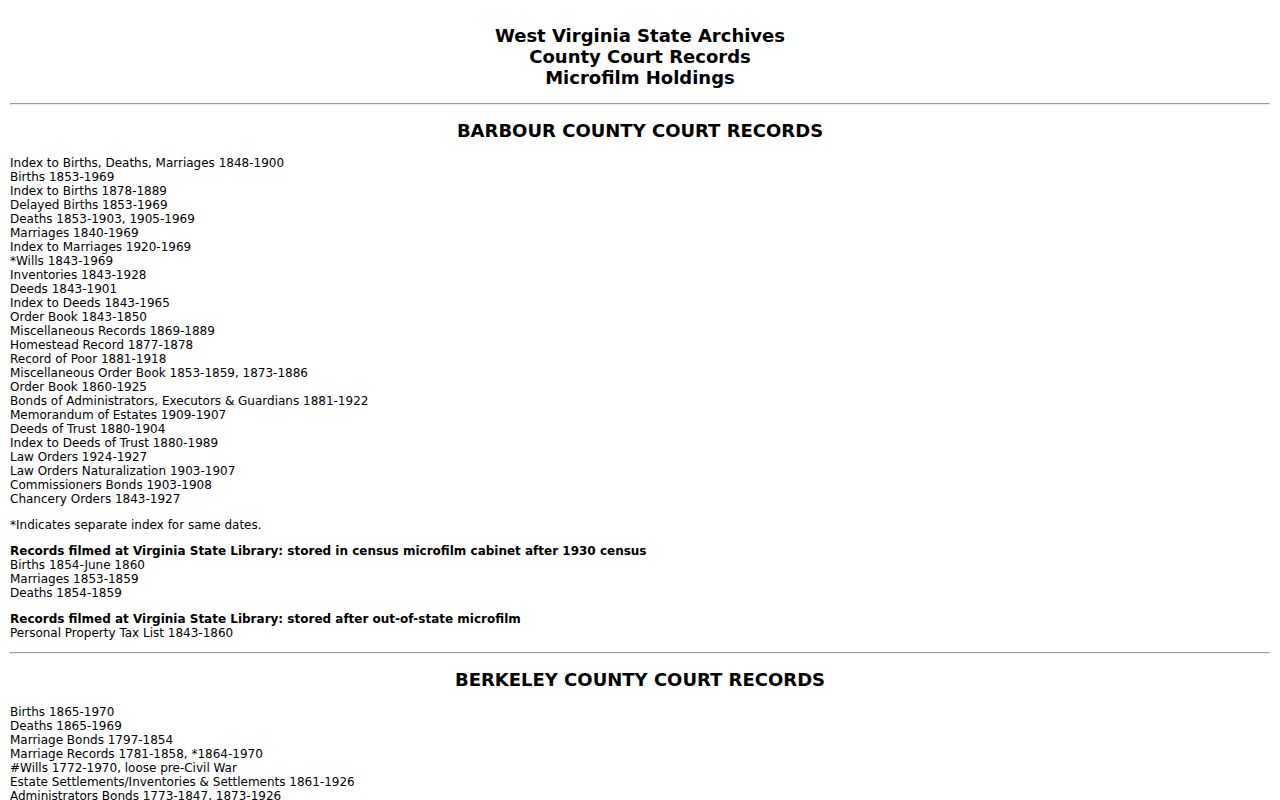
When the modern online search ends, carry the name forward. Bring the legal description and the last known deed reference into the older series at the archive.
Brooke Probate Can Explain a Transfer Gap
A tidy name-to-name chain can stall when land passed through an estate. Brooke probate files may hold a will, appointment, inventory, fiduciary bond, sale authority, settlement, and distribution. The executor's or administrator's deed is the transfer. Match it against the probate authority. A death certificate proves identity, not title.
Archives lists Brooke wills and indexes from 1797-1926, inventories from 1809-1928, and fiduciary materials into the early twentieth century. Later estate files are a County Clerk question. Search the decedent and fiduciary names along with the parcel's legal description.
Brooke Street History Helps Find Former Owners
Old Brooke County descriptions rarely match a modern street address. A farm, survey, road, creek, town lot, or neighbor's name may stand in instead. An 1871 Wellsburg map with entries can bridge a historic name to a street. So can local directories. Wellsburg has volumes for 1908-1912, Wellsburg/Follansbee volumes for 1975, 1979, 1982, 1984, and 1989, and Weirton runs covering 1971-1999 with gaps.
Directories show occupancy, not title. Pair each listing with deeds, probate, census material, or newspapers. The former genealogy collection now sits at the Brooke County Historical Museum by appointment, so confirm its location and copying rules before you travel.
Brooke Court Records Fill Chain Gaps
Partition, quiet-title, foreclosure, and lien-enforcement cases can explain a conveyance that looks nothing like an ordinary sale. West Virginia Judiciary supports circuit and magistrate searches statewide. A docket shows parties, filing dates, events, and disposition, but the full pleading, exhibit, or certified order may still require the Brooke Circuit Clerk. Dockets rarely use street addresses. Search names and legal descriptions instead.
A docket is a pointer, not the instrument. Look for the judgment, sale order, fiduciary deed, or recorded release that actually changed the land record.
How Far Back Brooke County Owner Records Reach
How far back can a Brooke County owner search go? The public County Clerk page names no confirmed end year for its modern online index. Check the latest date with the office directly. The Archives inventory reaches much deeper. It lists Brooke deed indexes from 1797-1948 and deed books from 1797-1901. Trust deeds, surveys, homestead declarations, judgment liens, oil and gas leases, court order books, and estate records fill out the historical record. These collections give any property records search real depth. They do not promise that every image is online.
Historical limit. Brooke County’s modern online cutoff is not verified in the clerk material reviewed. Confirm the current index with the clerk; for older transfers, use deed books and Archives microfilm rather than assuming the web search is complete.
Brooke County Former Owner Research Across Eras
A recent ownership change starts with the assessor card. Note the deed book and page listed there. Then retrieve the instrument from the County Clerk and read the granting clause, legal description, signatures, and recording notation together. A sales-history entry helps you locate the deed, but it cannot replace the filed instrument. Splits and combinations can also change a parcel number. When that happens, compare the description and adjoining tracts so you follow the right account through the deed records.
Older chains run through the Archives deed index. It leads to the right deed book and page. The inventory reaches deed indexes through 1948 and deed books through 1901. Trust deeds, judgments, releases, wills, and survey records appear there too. Probate files and court orders often explain why an estate or fiduciary signed as grantor. If the index points beyond the online range, ask the clerk or Archives about the book, microfilm, or copy process before assuming the record is missing.
Street names and house numbers shift over time. An 1871 map and Wellsburg directories from 1908 through 1912 can tie an old address to a present parcel. Weirton volumes span 1971 through 1999, with gaps. Follansbee and Wellsburg also survive in selected years. Treat each directory hit as a clue. Then verify the land itself through deeds, plats, and the assessor parcel keys. The former local genealogy collection now lives at the Historical Museum, open by appointment. Confirm access before you travel.
Brooke County Earlier Owner Names and Parcel Changes
A trustworthy former-owner sequence tracks the land, not just the names. One deed can divide or combine parcels. The modern account may not cover the whole earlier tract. So compare acreage, adjoining land, district, lot, and survey references. Then follow each resulting parcel into later Brooke County deeds. The Archives survey books and deed indexes can bridge an old metes-and-bounds description to a later lot or street address.
Court and probate records matter when a conveyance involves an estate, commissioner, trustee, or personal representative. Brooke will books in the Archives inventory run from 1797 through 1926. Court order books and judgment liens are separate series. Those entries explain the authority behind a conveyance. The later deed or order still governs the property description and its effect. Read it in full. Record the source, date, book, and page. That timeline is your proof of ownership.