
Brooke County Deed Records and Instruments
The Brooke County Clerk accepts deeds, mortgages, releases, liens, plats, and similar instruments for recording. They must meet the office's rules. A deed is the core record. It captures a conveyance along with the parcel's legal description. It also anchors the chain of title. A mortgage or deed of trust works differently. It records a lender's security interest in the property rather than a sale. A release or satisfaction then shows that an earlier claim was paid off and discharged. These instruments often sit side by side. They share the same land-record history for a single parcel.
| Deed Type | What It Does | Common Use |
|---|---|---|
| Deed of conveyance | Names parties and describes transferred land | Sale, gift, or other transfer |
| Fiduciary deed | Shows an executor or administrator acting for an estate | Estate transfer or court-authorized sale |
| Trust deed | Records an interest securing an obligation | Mortgage or other security record |
| Release / satisfaction | Identifies a claim later released or paid | Follow-up to a mortgage or lien |
| Plat / survey instrument | Maps lots, lines, or surveyed land | Subdivision and boundary research |
Instrument labels shift with the type of transaction. Read the full document rather than the label alone. The parties, legal description, execution and recording dates, and any prior-instrument reference tell the real story. A recorded deed is evidence of what entered the public record, not a full title opinion or proof that no other claim exists.
Brooke Deed Index Depth and Online Limits
The clerk's public page promises no modern index cutoff. It also gives no guarantee that historic images are online. The West Virginia Archives, by contrast, publishes clear historical scope. Its holdings include Brooke County deed indexes from 1797 through 1948 and deeds from 1797 through 1901. A supplemental inventory adds trust-deed and grantor and lien material reaching 1981. Treat that as a description of the collection, not a claim about the current web portal.
For recent instruments, use the clerk's Document Inquiry route. Ask the office directly which years and image options it supports. When your trail runs earlier, request the correct Archives microfilm or consult the local clerk. Confirm the fees for ordinary, certified, and recording copies before placing any order. The clerk's page publishes no complete modern price list.
The West Virginia Archives Brooke County listing catalogues the historic deed series. It also covers neighboring land materials. The county entry on that page displays the relevant holdings.
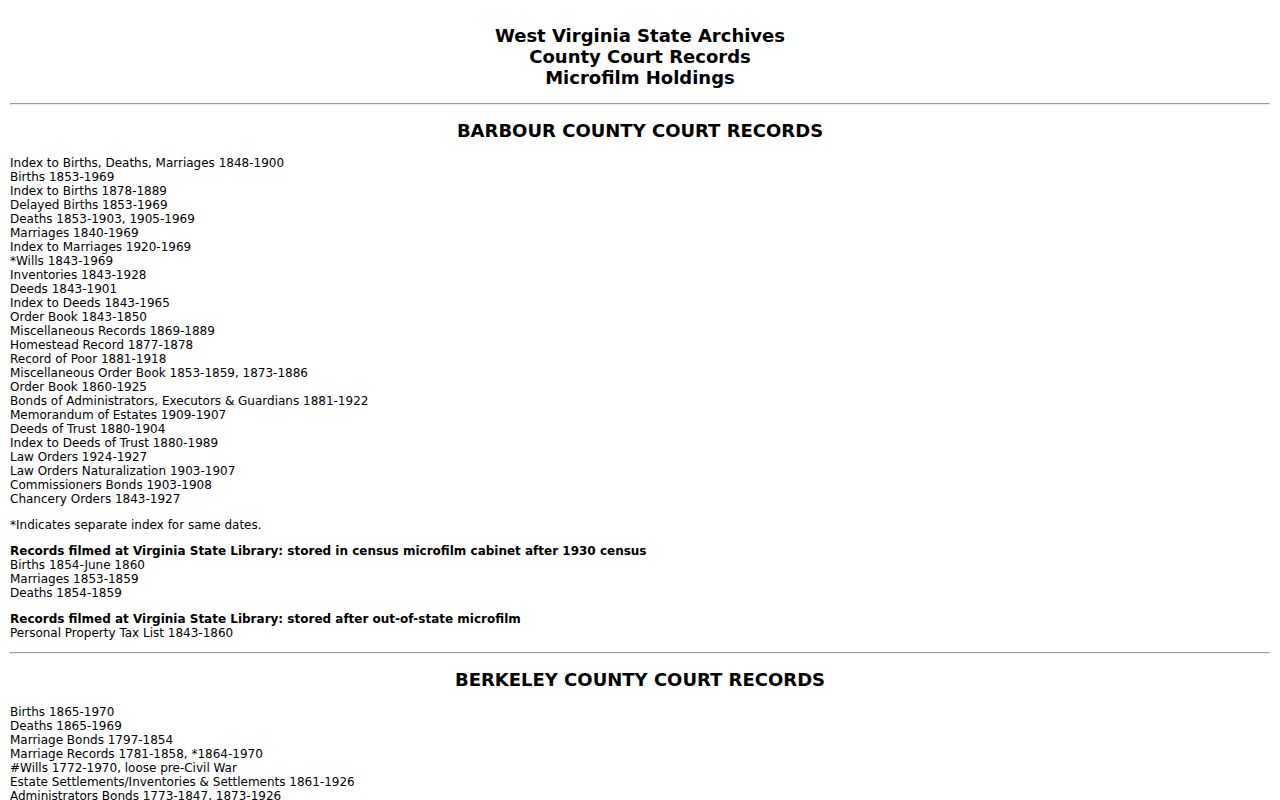
The archive groups its deed records into series by year. Pick the right span first. Then confirm which reel or book you can actually reach before you schedule a visit to Wellsburg.
Brooke Deeds, Trusts, and Release Records
Deeds are only the start of Brooke County land records. The archives also hold trust deeds with their own index, judgment liens, homestead declarations, oil and gas leases, and surveys. Releases are kept there too. Pull these alongside any conveyance deed. They can explain a mortgage, a mineral interest, or a boundary claim. A plain sale-history list never shows these.
Once you find the deed that created an interest, chase the instruments that follow it. A trust deed may carry an assignment or a release. A judgment lien may have a satisfaction on file. A lease can be terminated or assigned to another party. The County Clerk records each instrument, while enforcement actions sit in the court files. So a tidy chain of sales proves little. Encumbrances can linger well after the last recorded sale.
Using Brooke County Grantor and Grantee Entries
Start with the most recent deed. Read it closely for the grantor, the grantee, the deed type, the date, the book and page or instrument reference, and the legal description. The grantor conveys the interest. The grantee takes it. Next, search that earlier grantor's name as a grantee in the preceding period, and match the legal description before stepping back another generation. Names collide more than you might expect. Initials, married names, estates, trustees, and business entities all blur the trail.
- Use the assessor’s deed book/page or a known parcel to identify the latest instrument.
- Record both parties, the legal description, recording date, and any earlier deed reference.
- Search the grantor as grantee for the prior conveyance, checking initials and name variants.
- When the online trail stops, ask the clerk about current access and locate the older series through Archives microfilm.
- Grantor
- The party conveying an interest in the instrument.
- Grantee
- The party receiving the interest.
- Chain of title
- The sequence of conveyances that connects prior owners to the present record.
- Book and page
- A volume reference used to locate a recorded Brooke instrument.
What a Brooke Deed Entry Should Capture
Whether you read an index entry or a full copy, capture the fields another researcher would need. The fields should lead back to the same deed again. Note the book, the page, the date, and the parties. The County Clerk is the recording custodian, at 632 Main Street, Suite 201 in Wellsburg. Call 304-737-3661 for the current search endpoint and copy process. One caution applies here. A book and page pointer from the assessor is a lead only. It never replaces reading the instrument itself.
| Parties | Grantor and grantee names, including capacity or entity form |
|---|---|
| Dates | Execution and recording dates, when shown |
| Instrument key | Deed type, book/page or instrument number |
| Land description | Lot/block, tract, district, survey, and parcel references |
| Related records | Prior deed, plat, exhibit, release, or lien reference |
Plat and mortgage entries deserve a close look too: check the subdivision or lender named, the map reference, and any later release or amendment recorded against the deed. When a Brooke County deed comes out of an estate, the probate file should confirm the fiduciary's authority to sell.
Probate and Court Events Behind a Deed
Estate transfers can hide inside a chain that looks like a simple owner-to-owner sale. The County Clerk handles probate and estate matters alongside recorded land documents. A will can explain why an executor or administrator conveyed a parcel. So can an appointment, an inventory, a fiduciary bond, or a sale authority. The State Archives holds Brooke wills and indexes from 1797 to 1926. It also keeps inventory books spanning 1809 to 1928. Later files belong to the local clerk, so ask there first for anything recent. Litigation adds another layer. Quiet-title, partition, foreclosure, and lien-enforcement disputes may surface in court. Use the West Virginia Judiciary's circuit or magistrate search. Search party names and the legal description. Then read the pleading and the final order itself. A docket event is not a deed. When a court directs a sale or transfer, look for the resulting commissioner's or fiduciary deed in the clerk's land records. That is the instrument that actually moves title.
Old Brooke Property Descriptions
Brooke County land records reach back into predecessor-county and survey material. Archives lists Ohio County records referring to Brooke property from 1777-1801, surveys from 1780-1786, and a survey book covering 1797-1856. An early description may name a creek, road, farm, adjoining owner, or survey rather than a modern street address. Pair those words with district, lot, and nearby parcel clues when you search.
Local directories and newspapers can show how a place was used, but the deed or plat controls the recorded land description. Wellsburg has directory volumes from 1908-1912 and an 1871 map with entries. Weirton directories span much of 1971-1999. The former genealogy collection now sits at the Historical Museum by appointment, so call before relying on an old library reference list.
Requesting a Brooke County Deed Copy
The Brooke County Clerk's Document Inquiry system and the recording counter are the two routes for recorded-document research. The clerk page lists 632 Main Street, Suite 201, Wellsburg, WV 26070, phone 304-737-3661, and email barbetta@clerk.state.wv.us. No verified modern image cutoff or full copy-fee schedule is published. Ask whether the request is for an ordinary copy, certified copy, recording service, or image access, since those are different services.
Recorded, not guaranteed. Brooke County deed records show instruments placed in the clerk’s custody, but do not certify that the chain is complete or free of unrecorded interests. For a transaction, use a title professional to examine the chain.
Brooke County Deed Research Beyond the Current Index
Online name searches have limits. The West Virginia Archives inventory extends your reach well past them. It lists Brooke County deed indexes from 1797 through 1948. It also lists deed books from 1797 through 1901. Note that those date ranges differ. An index entry may point to a deed book page. No image may appear in a web viewer. Ask the clerk or Archives staff which volume fits the date you need. Ask them about microfilm or a copy service too.
Older land questions reach beyond deeds. Surveys, recorded plats, trust deeds, and homestead declarations all play a part. The Archives lists Brooke survey material from 1780 through 1786. It also lists a survey book covering 1797 through 1856. A trust deed can explain a security instrument recorded beside a conveyance. Judgment liens and releases may be needed to sort out later claims against the same parcel. That is why a deed search alone covers only one slice of a tract's recorded history.
Estate transfers take a different path. Brooke County will records in the Archives inventory run from 1797 through 1926. Probate records stay with the County Clerk. When an owner died before a later deed, find the estate or court record first. Compare the personal representative's authority with the deed that followed. Keep each citation with its book, page, date, and custodian. That way a later reader can retrace the chain of Brooke County property records. The reader will not mistake an index summary for the instrument itself.
Brooke County Deed Index and Instrument Trail
A solid deed citation names the grantor and grantee. It also gives the instrument date, recording date, deed book, and page. Follow both names across successive instruments. Searching only the person on today's tax card misses too much. A former owner may be indexed under a middle initial. The same person may appear under a married name, an estate, or a fiduciary capacity. The legal description is what keeps a name sequence tied to the same tract of land.
Brooke County was formed from territory reflected in earlier Ohio County records. The Archives inventory includes Ohio County material referring to Brooke land from 1777 through 1801. For a chain predating Brooke's own deed books, search those predecessor references alongside the county's survey records. Early descriptions may lean on a creek, an adjoining owner, a road, or a survey name. They may not give a modern parcel number. Record the archival series and page citation so the reference can be requested again.
After you locate a conveyance, the work is not done. Check whether a trust deed, lien, release, probate entry, court order, or plat changes how the transaction reads. A grantor's name on a deed does not prove every interest transferred. For certified copies or recording requirements today, follow the County Clerk's instructions and confirm any fee before mailing a request for Brooke County deed records.